Find Your Perfect Kitchen Layout
Your Space Parameters
Recommended: [Layout Name]
Based on your area of sq. ft.
Estimated Clearance Analysis
Walk into any home in London and you will see a different arrangement of cabinets and appliances. Some feel cramped while others seem to flow perfectly. The reason lies in the layout. When people ask which kitchen shape is best, they usually want to know how to make the most of their space without wasting a square foot.
The truth is that there is no single perfect shape for everyone. The right choice depends entirely on your room dimensions, how you cook, and who lives in your house. A design that works for a busy chef in a large country home might fail completely in a small flat in Shoreditch. You need to weigh efficiency against comfort.
Quick Summary
- L-Shaped Layout: Ideal for open-plan living and social cooking.
- U-Shaped Layout: Maximizes storage and counter space for serious cooks.
- Galley Layout: Best for narrow rooms where efficiency is key.
- One-Wall Layout: Perfect for studios or small apartments.
- Kitchen Island: Adds workspace but requires significant floor area.
- Work Triangle: The core principle connecting sink, stove, and fridge.
Understanding the Core Principles
Before picking a shape, you must understand how movement works in a kitchen layout is the spatial arrangement of cabinets, appliances, and floors designed to optimize workflow. Think of it as the skeleton of your room. If the bones don't fit, the muscles won't work correctly.
The most critical concept here is the Work Triangle is a design guideline connecting the three main work centers: sink, refrigerator, and cooktop. The total distance between these points should fall between 12 and 26 feet. If the corners are too far apart, you burn energy walking back and forth during meal prep. If they are too tight, you feel crowded when two people are working.
This triangle dictates functionality. For example, placing the dishwasher next to the trash bin makes cleanup faster because you can load dirty dishes immediately after chopping. It sounds simple, but bad placements ruin even the most expensive renovations. Many homeowners focus on aesthetics like tile or paint color first, which is backwards.
The L-Shaped Kitchen Layout
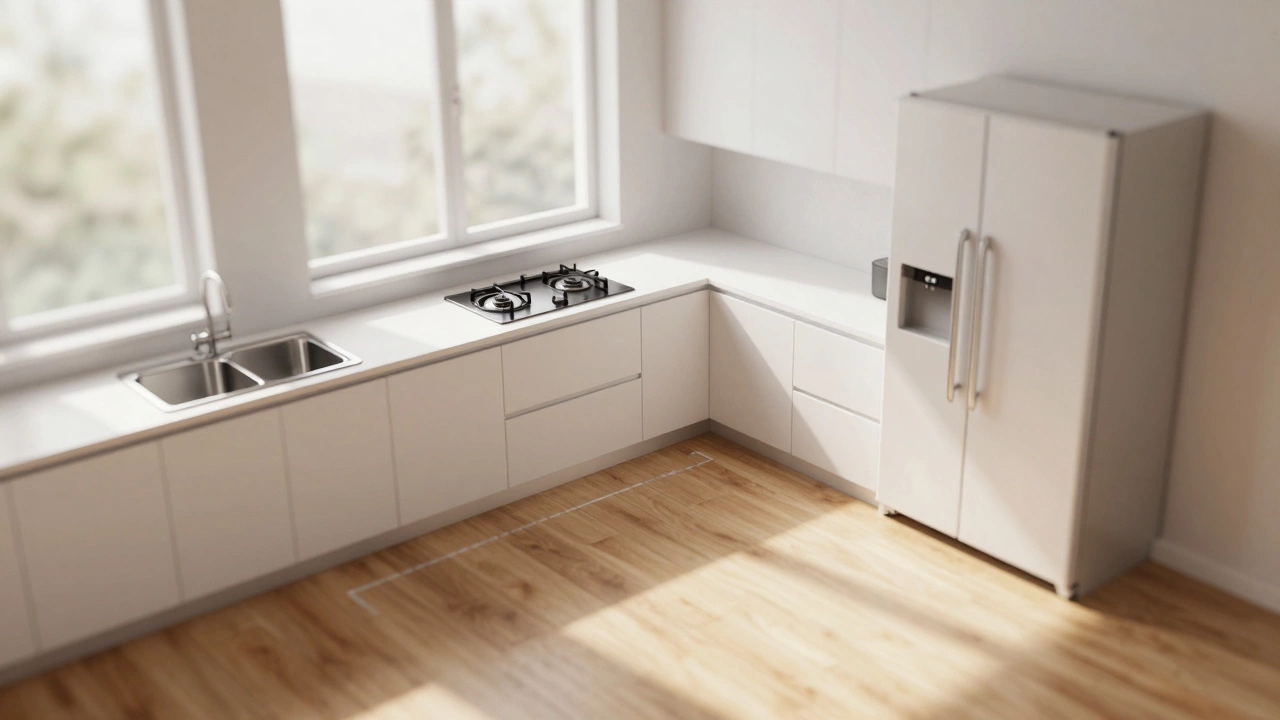
This configuration uses two adjoining walls at a corner. It is perhaps the most common choice for modern flats because it opens up the center of the room. An L-Shaped Kitchen is a layout using two perpendicular walls to form an L shape, leaving the middle open. This openness encourages conversation while you cook.
The major advantage is flexibility. Because the center is unblocked, you can easily add dining chairs or stools without obstructing traffic. Families love this setup because parents can supervise children playing on the carpet nearby. It also accommodates a small island later on if your budget expands.
However, corner cabinet space can be tricky. Deep angles sometimes become dead zones where jars get lost forever. Installing lazy susans or pull-out trays solves this, but they increase costs. Without those inserts, you lose a decent chunk of usable volume. Measure your corner depth carefully before ordering units.
The U-Shaped Kitchen Layout
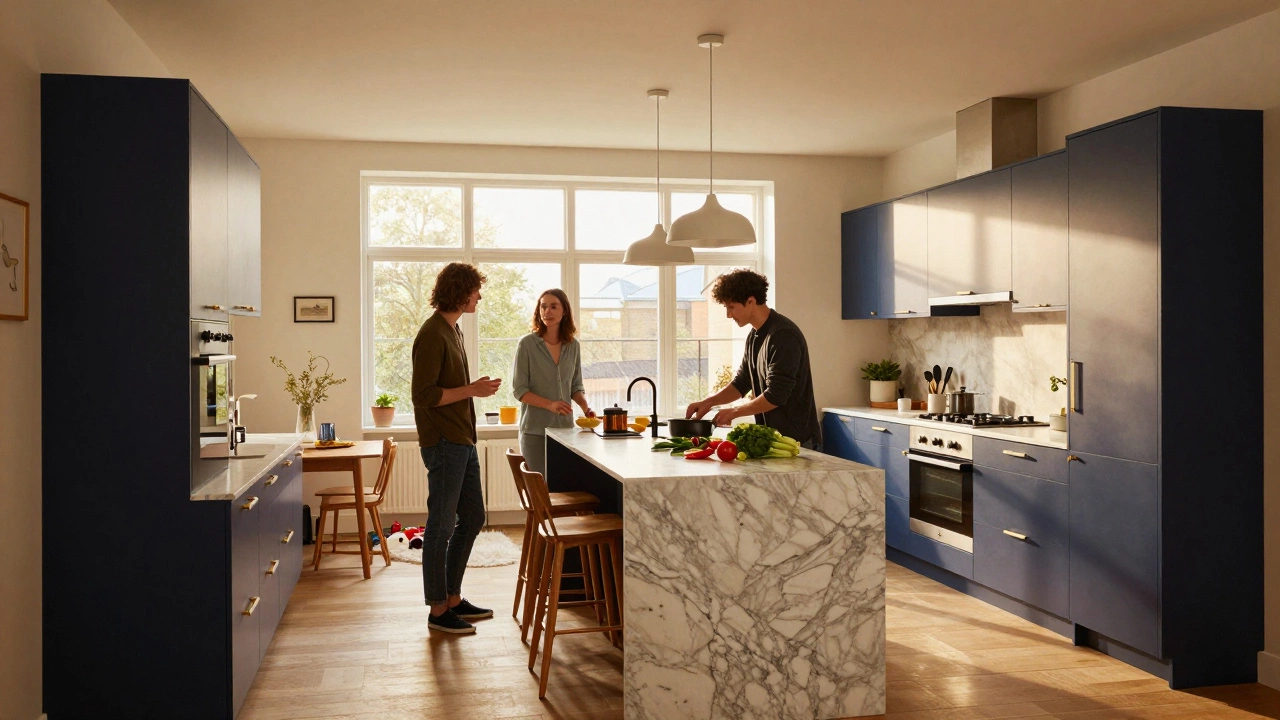
If you have wall space on three sides, consider a U-Shaped Kitchen is a layout enclosing the cook on three sides for maximum cabinetry and counter access. Imagine standing in a U, with counters on your left, right, and directly ahead. It offers the most countertop area per square foot.
Cooks who prepare meals from scratch appreciate this shape. Every tool has a place. You never run out of landing spots for your cutting board or mixer. Storage capacity is superior to other shapes, making it great for hoarding pots and pans or seasonal baking gear. The downside is that it creates a smaller footprint for walking around.
To prevent feeling trapped, ensure the distance between opposite counters allows a clear path. Ideally, leave at least 36 inches between opposing surfaces so doors can open and people can pass without bumping elbows. In narrow rooms, this layout can feel boxed in, blocking airflow.
The Galley Kitchen Layout
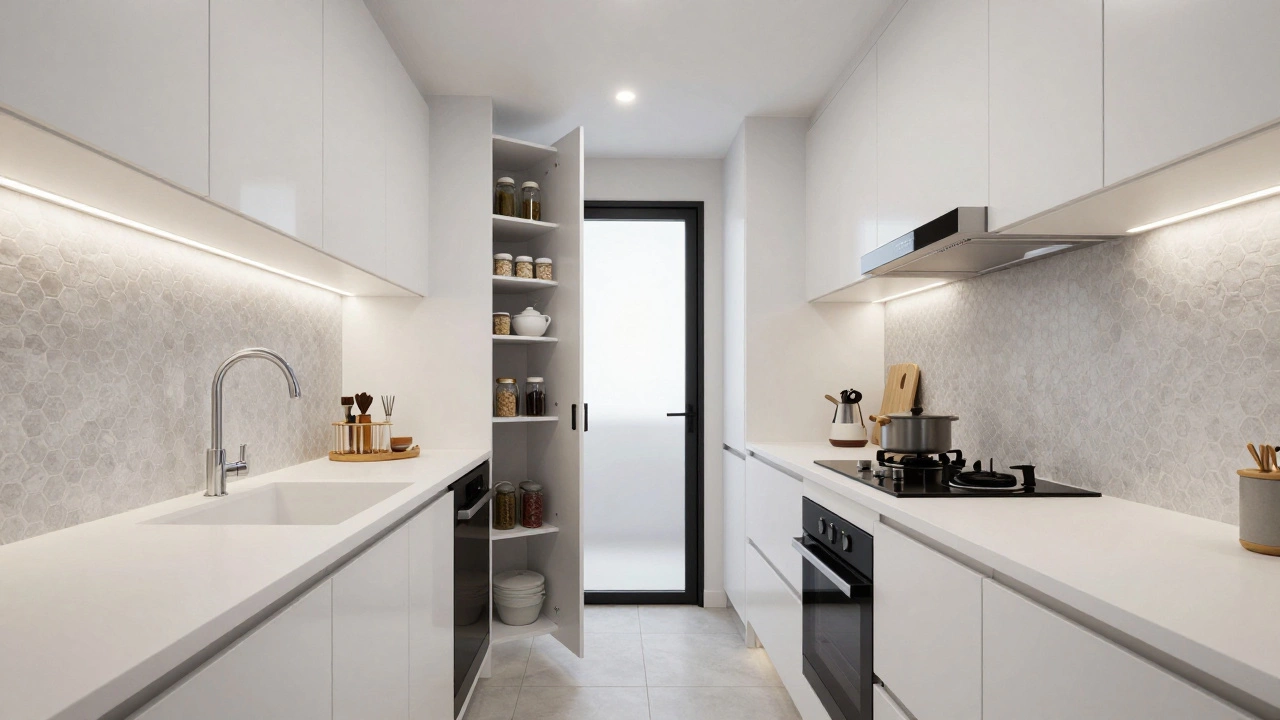
Sometimes called a corridor kitchen, this places runs of cabinets along two parallel walls. A Galley Kitchen is a narrow layout with counters on opposite walls forming a walkway in between. It is highly efficient because every step puts you in front of something useful.
You rarely waste motion here. Your hands always reach a surface to drop ingredients. Professional chefs often prefer this style for speed alone. However, it does not support multiple workers well. Two people trying to cook will collide constantly.
Lighting becomes essential in galley kitchens since windows might only be at one end. Install under-cabinet lighting to ensure safety on dark countertops. Also, ventilation matters more than usual since steam builds up quickly in narrow corridors without cross-ventilation.
Islands and Peninsulas
An Kitchen Island is a freestanding counter unit that provides prep space, storage, or seating. It is not really a shape itself but an addition to one. Adding an island transforms an L-shape into a functional hub.
Islands work wonders for entertaining. Friends gather around while you grill or stir. You face them rather than turning your back. But remember the clearance rule. You need 36 to 42 inches of walking space on all sides of the island. Squeezing one into a small room blocks pathways and feels cluttered.
A peninsula is similar but attached to a wall at one end. It saves a little space while offering the same seating benefits. It effectively closes off a kitchen entrance if positioned near a doorway, creating a semi-formal transition zone.
Choosing Based on Room Dimensions
Your physical limits dictate the choice more than style preferences. Small spaces (under 10 square meters) rarely accommodate islands or U-shapes effectively. There, a one-wall layout or a compact galley makes sense. Long rooms often suit galleries because length is abundant but width is scarce.
Tall ceilings in older Victorian houses allow for high-level cupboards to store infrequent items. Modern low-rise buildings benefit from stacking vertical storage since floor space is premium currency. Measure your floor plan twice. Sketching a diagram helps visualize traffic patterns better than mental guesses.
| Kitchen Shape | Ideal Room Type | Storage Capacity | Social Capability |
|---|---|---|---|
| Galley | Narrow or Corridors | High | Low |
| L-Shaped | Square or Rectangular | Medium | High |
| U-Shaped | Large Rooms | Very High | Medium |
| One-Wall | Studios or Small Flats | Low | Medium |
Budget and Installation Considerations
Renovating a kitchen in the UK involves strict building codes. Electrical and plumbing positions impact pricing significantly. Moving gas lines to fit a new island shape increases costs substantially compared to a simple swap of cupboard fronts. U-shaped designs usually require more linear meters of cabinets, raising material bills by 15% to 20% over an L-shape.
Labor time correlates with complexity. Custom fitting corners or curved islands demands higher skilled carpentry. Prefabricated systems limit shape flexibility but keep prices predictable. Always budget for unexpected issues behind old plasterboard or subfloor damage found during demolition.
Troubleshooting Common Layout Problems
Sometimes you pick a shape and realize it doesn't work after moving appliances. If the work triangle is too tight, shift the fridge away from the oven to reduce heat transfer issues. If traffic flows through the danger zone, install a sliding door or create a visual barrier using a half-height partition.
Poor lighting in a galley? Use recessed ceiling lights combined with task lighting strips under upper cabinets. Clutter buildup on islands? Add deep drawers underneath instead of open shelving to hide mess from visitors. These fixes are cheaper than starting over.
What is the minimum width required for a galley kitchen?
A comfortable galley kitchen requires a minimum floor width of 10 to 12 feet (3 to 3.6 meters). Less than that feels cramped when cabinet doors open.
Can I add an island to an L-shaped kitchen?
Yes, provided you maintain at least 42 inches of clearance around the island for safe movement and appliance operation.
Which shape saves the most money during construction?
The L-shaped or One-Wall layout typically costs less because they require fewer base cabinets and less plumbing redirection compared to complex islands.
Is the work triangle still relevant in 2026?
Yes, it remains a fundamental ergonomic standard, though open-plan living now blends cooking areas with dining to encourage zoning flexibility.
How much clearance do I need between opposite counters?
Standard clearance is 36 inches for a single cook and 42 to 48 inches if two people work simultaneously.