Construction Type Selector
Determine whether your construction project is civil or commercial based on these key characteristics.
People often use the terms civil construction and commercial construction interchangeably, but they’re not the same. One builds highways and water systems. The other builds offices, stores, and hotels. Mixing them up can lead to wrong expectations, budget mistakes, or even legal issues on a project. Knowing the difference isn’t just for engineers or contractors-it matters if you’re planning a business, investing in property, or just curious about how the world around you gets built.
Civil construction is about public infrastructure
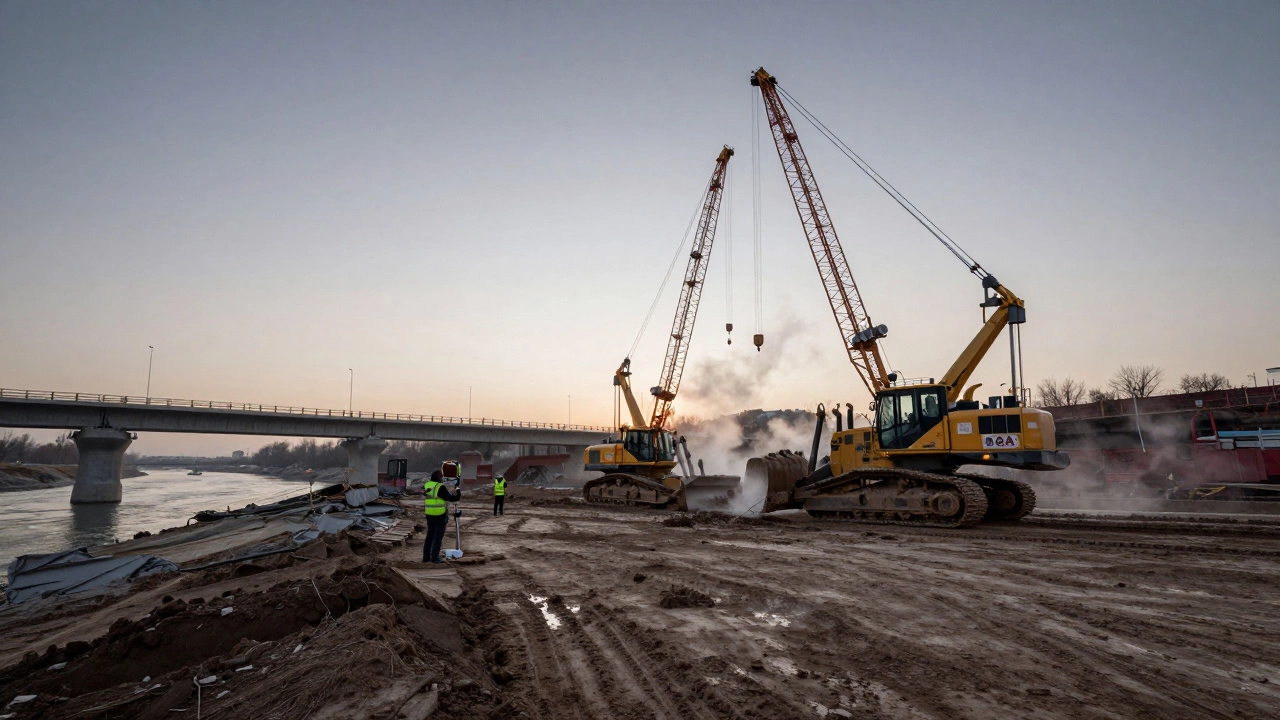
Civil construction handles the backbone of a community. Think roads, bridges, tunnels, dams, sewage systems, water treatment plants, and public transit stations. These aren’t buildings you walk into-they’re systems you use every day without noticing. A city’s water supply? That’s civil construction. The highway you drive on to get to work? Also civil.
Projects like these are usually funded by government agencies-city, state, or federal. They follow strict public safety codes and environmental regulations. Permits can take months. Bids are awarded through public tenders. There’s little room for creativity; the goal is durability, safety, and long-term function over aesthetics.
For example, building a new bridge across a river isn’t about making it look sleek. It’s about handling 50,000 vehicles a day for 75 years, surviving floods, resisting corrosion, and meeting federal load standards. Materials like reinforced concrete, steel girders, and drainage systems dominate. Work often happens in remote areas, with heavy machinery and long shifts. Teams include civil engineers, surveyors, and heavy equipment operators-not interior designers.
Commercial construction is about business spaces
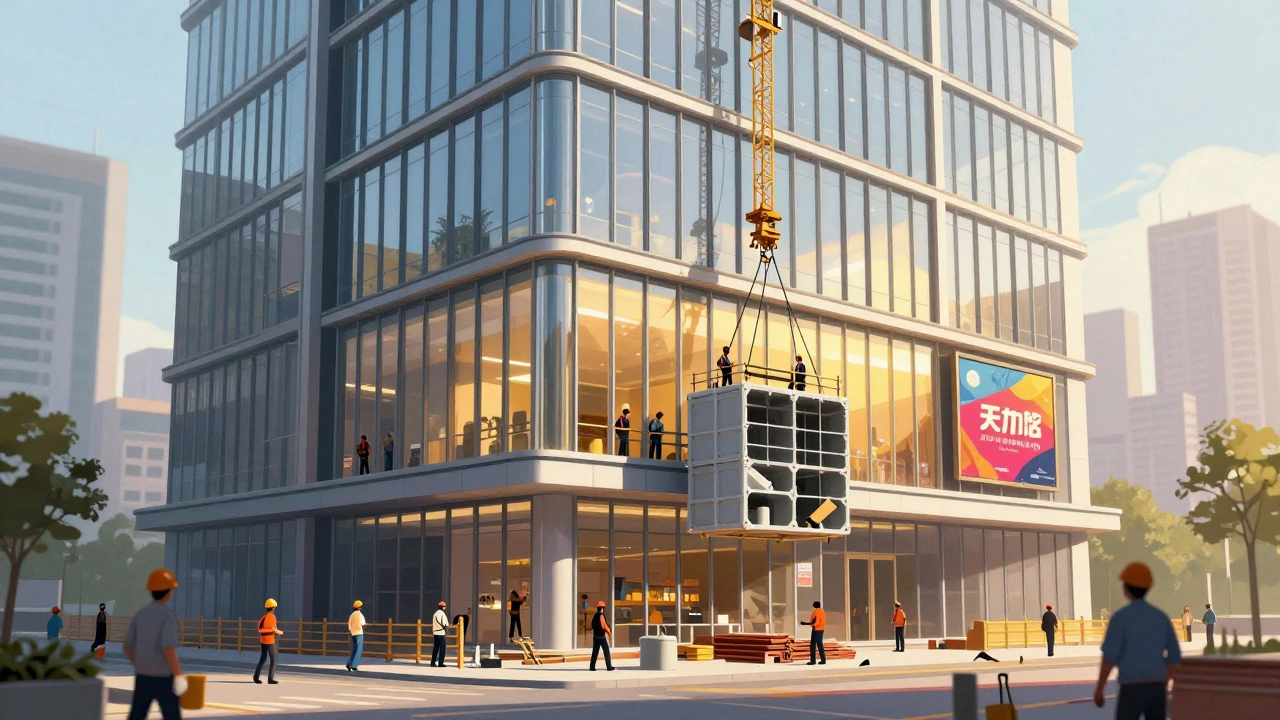
Commercial construction builds places where people work, shop, eat, or stay. Think office towers, retail malls, restaurants, hotels, hospitals, and warehouses. These are buildings designed for human activity, comfort, and profitability. A coffee shop’s layout, a bank’s security systems, a hotel’s HVAC setup-all fall under commercial construction.
Unlike civil projects, commercial work is almost always privately funded. A developer buys land, hires architects and contractors, and builds to attract tenants or customers. Speed and efficiency matter. Delays cost money. A retail space sitting empty for three extra months can lose tens of thousands in potential rent.
Materials here are more varied. You’ll see glass facades, drywall, acoustic ceilings, energy-efficient windows, smart lighting systems, and ADA-compliant ramps. The focus isn’t just on strength-it’s on appearance, airflow, noise control, and user experience. A hospital needs sterile environments. A gym needs high ceilings and durable flooring. A data center needs specialized cooling. Every detail serves a business function.
Design and planning are worlds apart
Civil projects start with topographical surveys and soil analysis. Engineers calculate load capacities for bridges or flow rates for sewer lines. They use models to predict how water will move during a storm or how traffic will shift after a new interchange opens. The design phase is heavily technical, often involving complex simulations.
Commercial projects start with market research. Who’s the target tenant? What do they need? How much natural light do offices require? What’s the foot traffic pattern in a shopping center? Architects design for human behavior, not just physics. A retail space might have curved walls to guide shoppers. A hotel lobby might use warm lighting to feel inviting. Even the placement of restrooms is strategic.
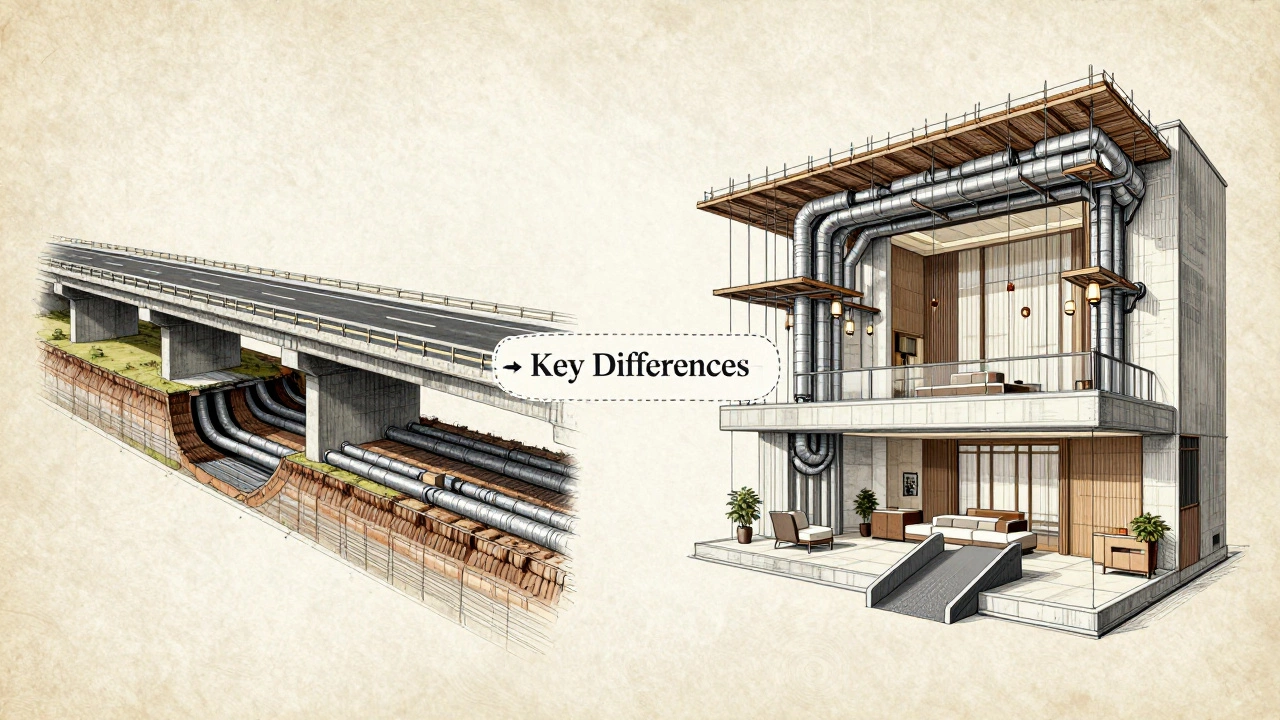
Civil blueprints are dense with engineering specs: PSI ratings, slope gradients, reinforcement schedules. Commercial blueprints include electrical layouts, plumbing risers, fire alarm zones, and furniture plans. One is about holding up the earth. The other is about making people want to stay.
Regulations and permits differ significantly
Civil construction is governed by public codes like the American Association of State Highway and Transportation Officials (AASHTO) standards, EPA environmental rules, and federal safety mandates. Permits often involve multiple agencies-transportation departments, environmental protection boards, even historical preservation committees if the project affects protected land.
Commercial construction follows building codes like the International Building Code (IBC), fire safety codes (NFPA), and accessibility standards (ADA). Permits are usually handled at the county or city level. The process is faster but more layered: zoning approval, architectural review, mechanical/electrical/plumbing inspections, occupancy certificates. Missing one step can halt the entire project.
For example, a new highway might need a 12-month environmental impact study. A new grocery store might need 45 days for zoning and 30 more for fire inspection. One is about protecting the environment. The other is about protecting people inside the building.
Timeline and budget expectations vary
Civil projects take years. A new bridge might take 5-8 years from planning to opening. Budgets are often in the hundreds of millions. Delays are common due to weather, permitting, or public hearings. Change orders are rare because funding is fixed-once the state approves $200 million, that’s it.
Commercial projects move faster. A mid-sized office building might take 12-18 months. A restaurant build-out can be done in 90 days. Budgets are tighter and more flexible. If a landlord wants to upgrade the lobby lighting after construction starts, they can usually pay for it. Profit margins drive decisions. A 10% cost overrun might mean a 20% drop in ROI.
On a civil project, you might wait six months for a permit just to start digging. On a commercial project, you’re racing to open before the holiday shopping season. The pressure isn’t just on the contractor-it’s on the entire team to deliver on time and on budget.
Who works on each type?
Civil construction teams are dominated by heavy equipment operators, civil engineers, geotechnical specialists, and surveyors. You’ll see large cranes, bulldozers, and asphalt pavers. Workers often live on-site for weeks. Communication is technical: "The compaction level on Layer 3 is 92%-needs to be 95%."
Commercial teams include architects, interior designers, HVAC specialists, electrical contractors, and project managers focused on tenant coordination. You’ll see drywall crews, electricians running conduit, and painters matching paint chips. Communication is more about schedules: "The flooring can’t go in until the HVAC is done."
What happens when they overlap?
Sometimes, the lines blur. A new hospital might sit on a site that requires road realignment. A large warehouse needs its own access road and stormwater system. In these cases, you’ll have a mixed project-part civil, part commercial. That’s when you need a contractor who understands both worlds.
For example, building a new Amazon fulfillment center isn’t just about putting up a big box. You need paved access roads, drainage basins, traffic signals, and utility hookups (civil). But you also need high-bay racking, conveyor systems, employee break rooms, and security checkpoints (commercial). One team handles the foundation and drainage. Another handles the interior build-out. Both must coordinate tightly.
Many general contractors specialize in one or the other. Trying to use a civil contractor for a retail build-out can lead to cost overruns and poor finishes. Using a commercial contractor on a highway project risks structural failure. Know which type you need before you sign a contract.
Why does this matter to you?
If you’re a business owner looking to open a store, you don’t need a bridge engineer. You need someone who knows how to install proper lighting for product displays and how to meet fire code for exits. If you’re a city planner adding bike lanes, you don’t need a retail designer-you need someone who understands traffic flow and drainage.
Even as a homeowner, understanding this helps. If your neighbor is building a new office next door, you might get noise, dust, and traffic changes. That’s commercial construction. If the city is repaving the street in front of your house, that’s civil. The disruptions are different. The timelines are different. The rules are different.
Getting this right saves time, money, and stress. You won’t waste months waiting for the wrong kind of permit. You won’t hire a contractor who doesn’t know how to handle a steel beam versus a drywall stud. You’ll make smarter decisions-from choosing a builder to planning your next big project.
Can civil construction include buildings?
Typically, no. Civil construction focuses on infrastructure like roads, bridges, and water systems-not buildings meant for occupancy. While some large public buildings like courthouses or schools are sometimes grouped under civil works in government contexts, they’re technically commercial construction because they’re designed for human use. The key distinction is function: if people live, work, or shop inside, it’s commercial.
Is a hospital civil or commercial construction?
Hospitals are commercial construction. Even though they’re often publicly funded or operated, they’re built as functional spaces for patients and staff. The design includes medical equipment integration, sterile environments, emergency power systems, and patient flow layouts-all hallmarks of commercial building. The infrastructure around it (like the road leading to it) is civil, but the building itself is not.
Which type of construction pays more?
It depends on the role and project scale. Large civil projects like bridges or tunnels often have higher total budgets-sometimes over $1 billion. But commercial projects move faster, so contractors can complete more jobs per year. Skilled trades like electricians and plumbers often earn similar wages on both. Project managers on commercial sites may earn more due to tighter deadlines and client pressure. Overall, commercial construction tends to offer more consistent, year-round work.
Can the same company do both civil and commercial work?
Yes, but it’s rare. Some large general contractors have divisions for each type. Doing both well requires different teams, equipment, and expertise. A company good at pouring concrete for a dam may not know how to install a high-efficiency HVAC system for a hotel. Most firms specialize because the skill sets, regulations, and client expectations are too different to manage under one roof without risking quality.
Which type is more affected by economic downturns?
Commercial construction drops faster during recessions. Businesses delay new offices, stores, or hotels when sales slow. Civil construction is more stable because governments still need to fix roads, update water systems, and maintain public safety-even in bad economies. Federal infrastructure bills often kick in during downturns to stimulate the economy, making civil work more resilient.
Whether you’re planning a new retail space or wondering why your city is tearing up the street, understanding the difference between civil and commercial construction helps you make better decisions. One builds the world around us. The other builds the places we live in. Knowing which is which isn’t just technical knowledge-it’s practical power.