
Fire Wall Rating Calculator
Calculate Your Fire Wall Requirements
Determine the required fire resistance rating for separating different construction types in your building project.
Required Fire Wall Rating
Key Requirements:
- Must extend from foundation to roof
- Must include fire-rated materials (e.g., 5/8" Type X drywall)
- Must seal all penetrations (pipes, wires, ducts)
- Must have fire-rated doors at openings
Critical Warning
Ever walked into a building and noticed one part looks like a steel skeleton while another feels like it’s made of wood and drywall? That’s not a mistake. It’s common-especially in commercial buildings-to mix construction types within a single structure. But is it legal? Safe? Practical? The answer isn’t yes or no. It’s yes, but only under strict rules.
What Even Is a Construction Type?
Construction types aren’t just about materials. They’re a classification system used by building codes to group buildings based on how they resist fire. The International Building Code (IBC) defines five main types: I through V. Each type has specific rules for what materials you can use in walls, floors, and roofs-and how long those materials can hold up in a fire.- Type I: Non-combustible. Steel and concrete. Think skyscrapers, hospitals, big-box retail.
- Type II: Also non-combustible, but with less fire resistance. Common in warehouses and shopping centers.
- Type III: Mixed. Non-combustible walls, combustible roof and floors. Think brick-and-wood storefronts.
- Type IV: Heavy timber. Thick wood members that char slowly. Rare, but used in historic renovations and some modern eco-builds.
- Type V: Wood-frame. Most common in offices, small retail, and apartments. Easily combustible.
These aren’t just technical labels. They determine insurance rates, fire department response plans, and even how many people can safely occupy a floor.
Why Mix Construction Types?
You don’t mix types because you want to. You do it because you have to.Take a typical urban retail building: ground floor is a grocery store with heavy shelving, refrigeration units, and high foot traffic. The upper floors are offices. The grocery side needs fire-resistant walls to contain potential grease fires or electrical faults. The offices? No such risk. So why build the whole thing in steel when wood would do for the upper floors?
Cost savings. Speed. Flexibility. You’re not cutting corners-you’re matching the construction to the actual risk. A Type I base supports heavy loads and fire hazards. Type V above keeps construction costs down and lets you add more floors without over-engineering.
How It Actually Works: The Fire Wall Rule
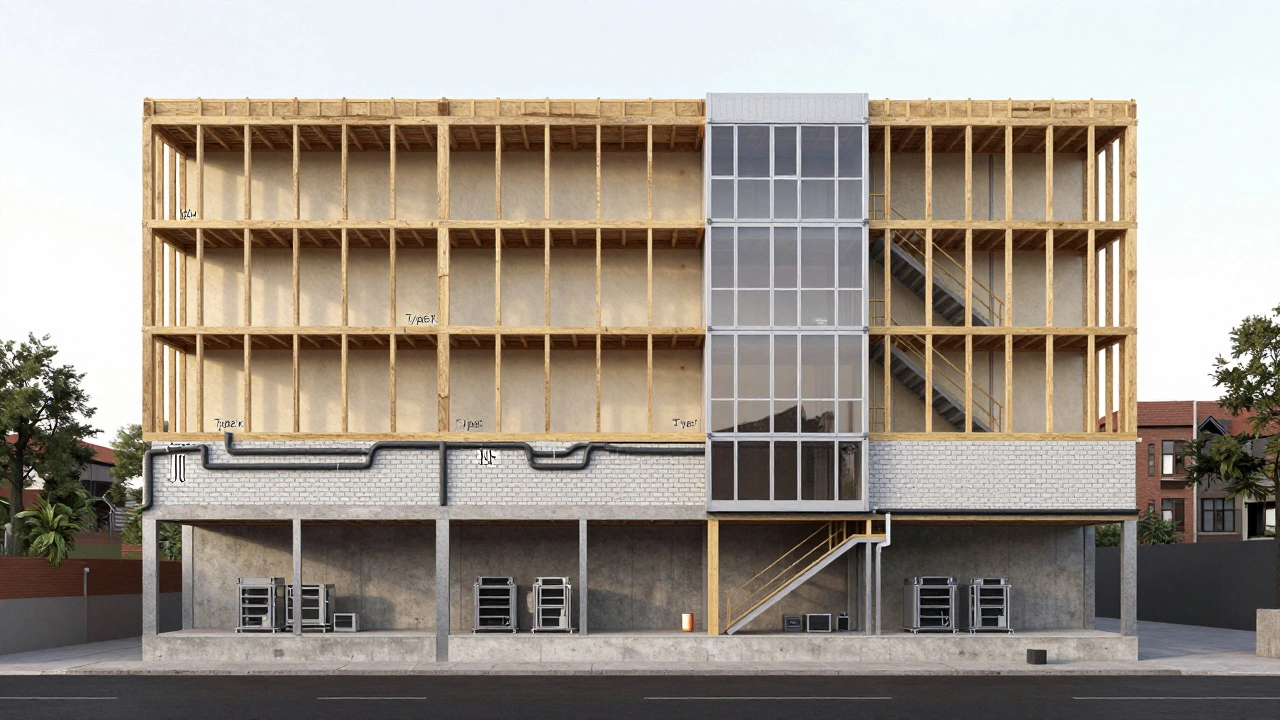
The key to mixing construction types? Fire walls.Building codes allow different construction types on different parts of a building-but only if they’re separated by a fire-resistance-rated barrier. This isn’t just a drywall partition. It’s a 2- to 4-hour rated wall that extends from foundation to roof, with no gaps, penetrations, or weak spots.
Imagine a 6-story building:
- Ground floor: Type I (steel frame, concrete slab)
- Floors 2-6: Type V (wood framing, gypsum board)
Between floor 1 and floor 2, you install a 3-hour fire wall. It’s built with double layers of 5/8-inch Type X drywall, steel studs, and sealed penetrations. Any ducts, pipes, or electrical conduits that pass through it are wrapped in fire-stopping material. This wall acts like a firewall between two separate buildings-even though they’re physically connected.
Without this barrier, mixing types is a code violation. With it? It’s standard practice in cities like London, New York, and Toronto.
Real-World Examples
In London, you’ll find this everywhere. A former warehouse in Shoreditch? Ground floor converted into a high-end restaurant (Type I for kitchen equipment and grease ducts), upper floors turned into co-working spaces (Type V). The fire wall between levels was retrofitted with steel-reinforced concrete panels and fire-rated doors.Another example: a 1970s office block in Birmingham. The original structure was Type II. A new annex was added in 2023 with a timber-frame roof and exposed wood ceilings (Type V). The connection point? A 4-hour fire wall with fire-rated glazing and automatic fire dampers in HVAC ducts.
These aren’t exceptions. They’re normal. Architects and contractors plan for mixed types from day one. It’s not a workaround-it’s a design strategy.
What Can Go Wrong?
The biggest risk isn’t the materials themselves. It’s the connections.Fire walls fail when:
- Electricians drill holes for cables and forget to seal them with fire-rated caulk.
- Plumbers run pipes through the wall without installing fire collars.
- Contractors use lightweight drywall instead of the required 5/8-inch Type X.
- Fire doors are propped open for convenience.
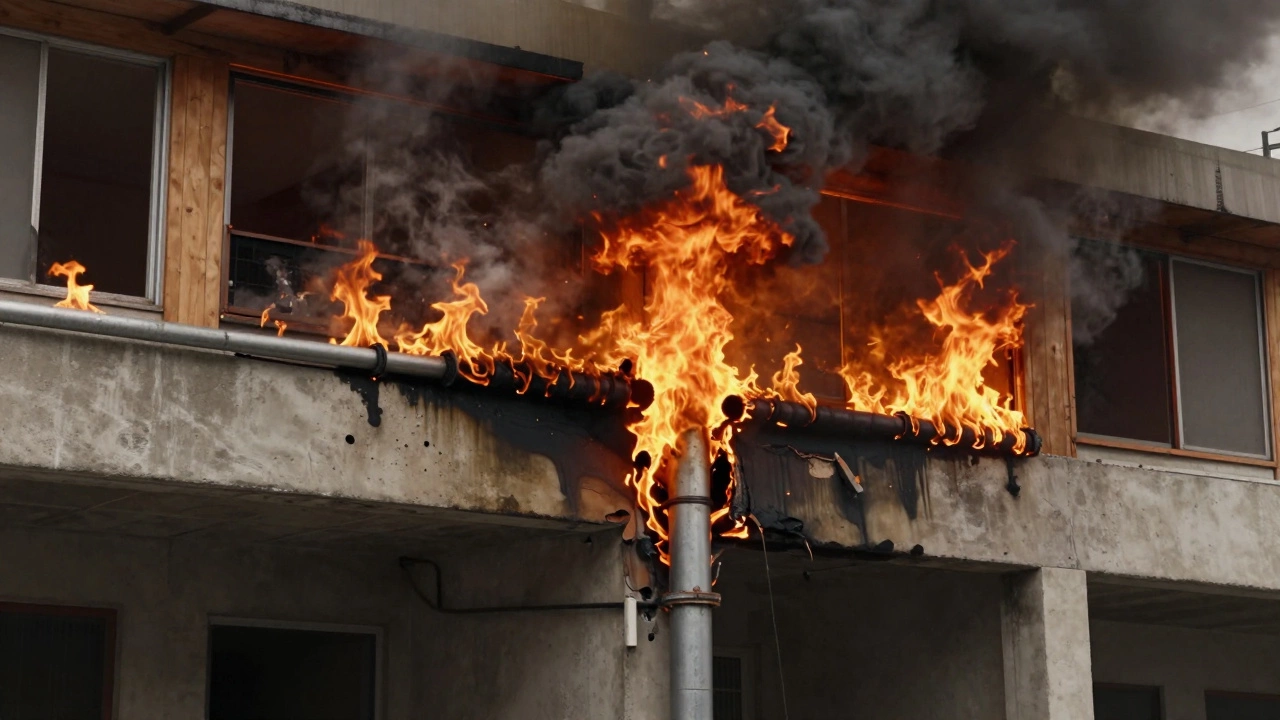
These aren’t just code violations. They’re life-safety failures. In 2022, a fire in a mixed-use building in Manchester spread from a Type V office section to a Type I retail area because a fire wall had been compromised during a renovation. Three people were injured. The building was condemned.
Inspections are strict. Fire marshals check every penetration. They use smoke tests and thermal imaging to find hidden gaps. One missed seal can shut down an entire project.
Who Decides What’s Allowed?
It’s not the architect’s call alone. It’s a team effort:- Architects design the layout and specify construction types per zone.
- Structural engineers ensure the building can handle mixed loads.
- Fire protection engineers design the fire walls, sprinklers, and smoke control systems.
- Building inspectors verify compliance during and after construction.
Each jurisdiction has its own interpretation of the IBC. In the UK, the Building Regulations Part B covers fire safety. In the US, local authorities adopt the IBC with amendments. Always check your local code. What’s allowed in Leeds might not fly in Bristol.
Is This Trend Growing?
Absolutely. Urban infill projects-where you build on small, irregular plots in existing neighborhoods-often demand mixed construction. You can’t always demolish the old structure. So you preserve part of it (say, a brick facade from the 1920s) and add a modern wood-frame extension on top.Modern timber construction (like cross-laminated timber) is making Type IV and Type V more viable even in taller buildings. Combined with fire-rated assemblies, this opens up new possibilities for mixed-use projects without resorting to expensive steel.
Developers love it because it cuts costs by 15-25% compared to all-steel builds. Fire safety systems are now smarter too-sprinklers, alarms, and compartmentalization reduce the need for over-engineering.
What Should You Do If You’re Planning a Project?
If you’re thinking about mixing construction types in your commercial building, here’s your checklist:- Define the fire hazard for each zone. Is it a kitchen? A storage room? An office?
- Match the construction type to the hazard. Don’t overbuild. Don’t underbuild.
- Design a fire wall that meets code for separation. Get it stamped by a fire engineer.
- Plan penetrations early. Every pipe, wire, and vent needs a firestop solution.
- Work with your local building authority before submitting plans. Don’t assume your architect knows the local quirks.
- Document everything. Inspectors will ask for proof of fire wall ratings and material certifications.
Don’t treat this like a DIY project. Mixing construction types is legal, but it’s not simple. One wrong detail can cost you months-or worse.
Bottom Line
Yes, you can have two construction types in one building. But you can’t just slap wood on steel and call it done. It takes planning, precision, and respect for fire safety rules. When done right, mixed construction saves money, increases flexibility, and makes smarter use of space. When done wrong, it’s a death trap.The best buildings don’t look like they’re patched together. They look like they were designed that way from the start. Because they were.
Can you mix Type I and Type V construction in the same building?
Yes, but only if they’re separated by a fire-resistance-rated wall that meets local code requirements-usually 2 to 4 hours of fire resistance. The wall must extend from foundation to roof and seal all penetrations like pipes, wires, and ducts. Without this barrier, mixing types is a code violation.
Is mixed construction cheaper than using one type throughout?
Usually, yes. Using Type V (wood-frame) for low-risk areas like offices or storage saves 15-25% compared to building the whole structure in steel (Type I). The savings come from lower material and labor costs. But you must budget for the fire wall and firestopping systems, which add cost but are far less than a full steel build.
What’s the most common mistake when mixing construction types?
Failing to properly seal penetrations. Electricians, plumbers, and HVAC techs often drill holes through fire walls and forget to use fire-rated caulk, collars, or sleeves. These small gaps let smoke and fire spread quickly. Inspectors catch this during final checks-and it’s one of the top reasons projects get delayed or fail.
Can you use timber framing above a concrete base?
Yes, and it’s increasingly common. Many urban renovations in London and Manchester combine a concrete ground floor (for retail or heavy equipment) with modern timber-frame upper floors. The key is a properly rated fire wall between levels, along with fire-resistant cladding and sprinklers. Cross-laminated timber (CLT) is now approved for mid-rise buildings in many jurisdictions.
Do insurance companies care about mixed construction types?
Yes, and they check. Insurers require proof of code compliance, especially fire wall ratings and sprinkler systems. If a building has mixed construction without proper separation, insurers may deny claims after a fire-or charge higher premiums. Always provide your insurance provider with the fire separation drawings and inspection reports.
What if my building already has mixed construction and I want to renovate?
You must verify the existing fire separation is still intact and up to current code. Older buildings often have gaps, unsealed penetrations, or non-rated drywall. A fire protection engineer should inspect the wall between zones. If it’s compromised, you’ll need to upgrade it before proceeding with renovations. Don’t assume it’s safe just because it’s been there for 20 years.